
TypeScript Academy Learning Platform
A TypeScript learning platform built around a type visualiser — the real compiler, in your browser, showing what it infers.
- tests, 733 server + 1,741 client
- 2,474
- forward-only migrations
- 29
- routes in the WCAG 2.2 AA CI gate
- 25
- TypeScript-specific grading bypass found and closed
- 1
Feature-complete and runs locally by design — it is not hosted, and that is a deliberate choice rather than a pending step. The repository is private; a demo is available on request.
The problem worth solving
TypeScript’s subject matter is compile-time, and by the time code runs every type has been erased. Inference, narrowing and generics are therefore hard to learn by running a program, and a course that grades only on runtime behaviour never checks the thing it is teaching.
How it works
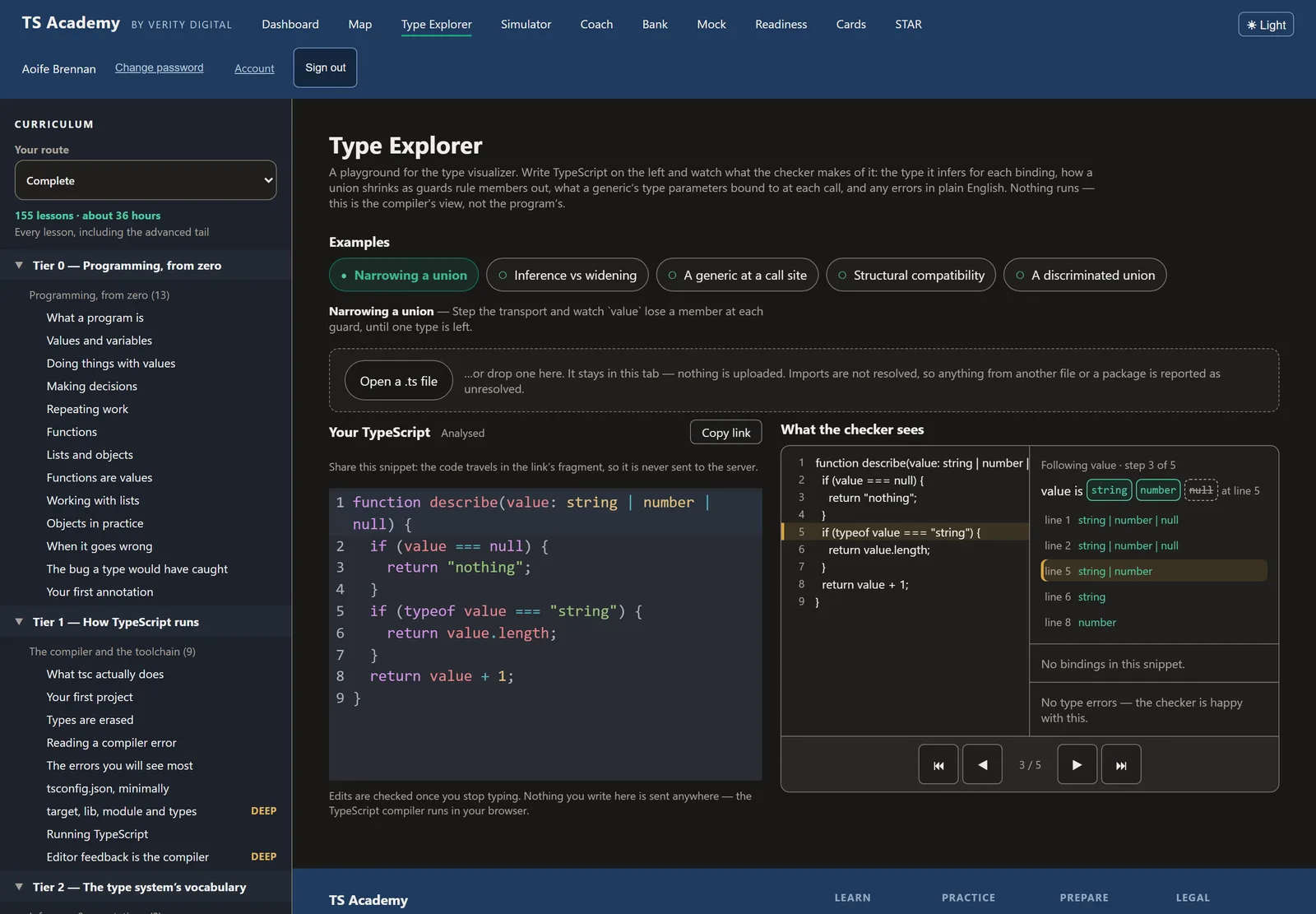
TypeScript Academy teaches the language around a custom type visualiser: the TypeScript compiler running in the browser to show what the checker infers, how a value narrows through a branch and what a generic resolves to, with plain-English diagnostics instead of raw compiler text. Beside it sits a step-through execution visualiser that shows what survives type erasure at runtime. Around them is a nine-tier, 195-lesson curriculum from absolute beginner to interview-ready, with server-verified assessment in which a type error fails a submission just as a wrong answer does, and an AI-powered interview-prep suite. It was forked from JS Academy, my earlier learning platform, with the git history intact; the type visualiser is the part JS Academy does not have. Authors add lessons through a role-gated admin console.
What the business gets
- A type visualiser that runs the real checker: inferred types per binding, control-flow narrowing with ruled-out members struck through, generic resolution and structural compatibility
- A module-resolution trace that runs the real resolver under nodenext and bundler and shows the compiler’s own --traceResolution output, and a declaration view that labels each declaration as a value, a type or both
- 37 type-check challenges where compiling is the pass condition, graded by the real compiler on the server before any tests run
- A nine-tier, 195-lesson curriculum with 522 quiz questions, a three-step hint ladder and 288 “recommended first” prerequisite edges that guide but never block
- A step-through execution visualiser that reads TypeScript by transpiling it and mapping positions back through the source map, with 42 predict-stops that ask what happens next
- An AI-powered interview-prep suite behind a daily token budget, optional and a clean no-op when no key is set
- A role-gated admin console to author lessons with a structured editor and live preview, and an audit log of admin actions
- An opt-in public profile, plus data export and erasure to GDPR Articles 15, 17 and 20
- Every one of 25 routes scanned by axe-core against WCAG 2.0, 2.1 and 2.2 A and AA with zero violations — automated scanning, not a screen-reader audit
- A written security assessment whose one TypeScript-specific finding is recorded with its fix and how the fix was checked
Screens
Verified 2026-10-10. Test counts are from the latest green CI run in typescript-academy (run 38086627367, 2026-10-10: server 733 tests, client 1,741, 2,474 in total) and were not re-run; earlier runs that day failed. Migrations (29) are a file count of server/src/db/migrations. The 25-route accessibility gate is a count of the routes listed in client/e2e/axe.spec.ts (11 public, 10 signed-in, 4 admin). Runs locally by design — not hosted, and that is a deliberate choice rather than a pending step.